Showing posts with label historical. Show all posts

Friday, March 22, 2013

REVIEW: The Leopard Prince by Elizabeth Hoyt

Published 2007

The theme for March's TBR Challenge, hosted by Wendy the Super Librarian, is 'Series Catch-up.' To say I had numerous series to chose from would be a serious understatement. I would wager that most of the books on my TBR pile are part of series. However, since I read The Raven Prince by Elizabeth Hoyt for last month's challenge and it is the first book in The Princes Trilogy, I thought it would be productive of me to just keep going and read the second book--The Leopard Prince, this month, which I did. I enjoyed it even more than The Raven Prince! Needless to say, I'm enjoying this trilogy and plan to read the third and final book, The Serpent Prince, shortly. I even gave myself a sneak peek by reading the first chapter last week.

I included images of two different versions of the cover art for The Leopard Prince in this post. Usually I just use the cover art for the version I own, which is the first one shown below--the original art work, but in the case of this book, I wanted to also share the newer version of the book cover because the models on that book cover look exactly how I pictured them--a rare occurrence, that!

The original cover art of
The Leopard Prince
The Leopard Prince features Harry Pye --a close friend of Edward de Raaf, Earl of Swartingtham whom readers met in The Raven Prince [see my review HERE]. In The Leopard Prince, Harry Pye has been hired as the land steward to the wealthy Lady Georgina Maitland who inherited a vast estate in Yorkshire from her late Aunt. It is extremely unusual for a woman to own land and property like Lady Georgina does, and honestly she knows very little about managing an estate. She is conscientious nonetheless and visits the estate to investigate rumors that someone from her land has been poisoning sheep on the nearby lands owned by the vile Lord Granville. No one in Yorkshire likes this man - not even his own servants and barely his own family. Quite simply, the guy's a major asshole.

Lord Granville is Harry Pye's sworn enemy since he was a child. His father was gamekeeper for Lord Granville, who at one point had had both him and his father horsewhipped and sent to the poorhouses of London. It's no coincidence that Harry pursued the position of land steward to the Maitland properties just to be nearby to irritate Granville as much as he could. Ultimately, because of this deep seeded animosity between Pye and Granville, Pye is the most likely suspect for the sheep poisonings. Nearly everyone thinks it's Harry behind the trouble, except for Lady Maitland.

Newer cover art for
The Leopard Prince
Lady Georgina is talkative, confident and has a really fun sense of humor. It takes a few meetings for Harry to realize Georgina is not just a shallow, wealthy woman interested only in jewels, gowns and balls, but is genuinely concerned for the people and land in her estates. He starts to really see the intelligent, confident and beautiful woman she really is and in turn, Georgina discovers the knowledgeable, caring man Harry is--one with the confidence and strength to do what's right by the land and its people. It's no wonder these two fall in love as they spend time together investigating the sheep killings.

I loved this trope of the Lady and her servant falling in love. For me, it was great fun to read a sort of role reversal of the prince falling in love with the poor village girl. It worked really well, too, because while Harry may not be born into nobility, he's by all means of noble character. Except, perhaps, when he has Lady Georgina in his arms. Actually, that's not entirely true. He's still rather noble in that he never takes advantage of her and he makes sure Lady Georgina knows exactly what she's getting into when she starts an affair with him and that she truly wants it. The inner conflicts Harry and Georgina struggle with in order to do best for the other were realistic and I appreciated the pace at which the conflicts arose and were resolved--not to rushed and not drawn out, and kept interesting and exciting right to the very end. In fact, to say the story ended with a bang would be quite accurate.

I adored The Leopard Prince and look forward to reading the final book in the trilogy, The Serpent Prince, which features Lord Simon Iddesleigh, close friend of Edward de Raaf and Harry Pye.

4.5 out of 5 stars on goodreads. If one could give half stars, that is.

GRADE: B+

Next month's TBR Challenge theme is 'New-to-you Author.' In other words, a book from your TBR by an author whom you have not yet read.


Sunday, February 17, 2013

The Winter Sea Group Read: PART II

I finally finished reading The Winter Sea the other day and am so excited to post this book discussion for the group read. My apologies for taking so long to read this book. It took me three weeks to read, but rest assured it was not a result of lack of interest, but a mere shortage of reading time that kept me from devouring it. If it wasn't for feeling guilty for holding up the book discussion, I would say that I'm rather glad it took me a while to finish this book, because it is one worth savoring. The Winter Sea is a well written, well paced, interesting work of fiction and wonderfully laced with romance.

The Winter Sea is often referred to as time travel historical fiction, but I consider it more of a clever blend of contemporary and historical fiction in one story. The story is told from two alternating perspectives. One is the first person point of view of Carrie McClelland, a successful Canadian writer of historical fiction who is writing a novel surrounding the events leading up to the Jacobite Rebellion in Scotland in 1708 as the exiled James Stewart seeks to reclaim his crown. While visiting her agent and friend in Scotland, the ruins of Slains Castle call to Carrie and she fells compelled to rent a cottage in the area so that she can properly research and write her book. She rents a cottage from a local man, Jimmy Keith and befriends his two sons Stuart and Graham, falling romantically for the latter.

The other perspective is told from the third person, following a young woman named Sophia Paterson who arrives at Slains Castle in the early 1700s to stay with a distant relation, the Countess of Erroll and takes place over a couple of years surrounding the events of the Jacobite Rebellion in 1708. It is at Slains Castle where Sophia learns of the stirrings of a rebellion on behalf of James Stewart --James VIII of Scotland and III of England, to reclaim his crown. This is also where she meets and falls in love with Mr. John Moray, a man trusted by Queen Mary herself (the birth mother of James Stewart) closely embroiled in the rebellion. Their story is a heartbreaking one full of danger and secrecy, but also one of hope and survival.

Since the purpose of this post is to lead a group discussion of The Winter Sea by Susanna Kearsley, I am going to assume that everyone reading this has already read the book. If you have not read the book, be warned that there are spoilers in the remainder of this post as well as in the comments. If being spoiled is not you're thing, I suggest you click away and come back after you've read The Winter Sea. I hope you do, as it is worth reading.

WARNING: SPOILERS AHEAD! Read at your own risk.
. . . . . . . . . . . . . . . . . . . . . . . . . . . . . . . . . . . . . . . . . .

The main character of The Winter Sea, Carrie McClelland, is a writer of historical fiction. Throughout the book, it is as though we are looking over her shoulder witnessing how she conducts research, finds inspiration and writes as much as she could whenever her muse strikes. I loved this glimpse into the life of a writer and found it realistic and informative. Did you enjoy this aspect of the story as well? Any thoughts?

Many readers categorize The Winter Sea as time travel fiction. I'd rather say it is a clever and sophisticated meld of contemporary and historical fiction in one cohesive story. Kearsley uses the concept of genetic memory -- Carrie's ability to share some of the memories of her ancestors, to weave these two story lines together. Did the concept of genetic memory work for you in this story?

Kearsley's writing is beautiful -- richly descriptive without being the least bit excessive. The quality of the writing and even Kearsley's choice of words themselves, kept me captivated. Do you know someone who is so good at telling stories that their mere voice can lull you in and you feel as though you could listen to them talk about anything--even a trip to the grocery story or filing their taxes and you are fully absorbed in their story telling? That's what reading Kearsley's work is like. It flows so richly and naturally in your head that you just want it to go on and on. What is your opinion on Kearsley's story-telling voice?

There are many beautiful passages and memorable quotes in The Winter Sea. The following are among my favorites:

Colonel Graeme to Sophia [p.352 ebook]
'Aye,' he said, 'there is no sight so melancholy as the winter sea, for it does tell us we are truly at the ending of the year, and all its days are passed, its days of joy and sorrow that will never come again.'
Then a bit farther down the page, again spoken by Colonel Graeme to Sophia...
'For if there was no winter, we could never hope for spring.'
And later in the book among pages where my heart broke the most.. [p.451 ebook]
How did you tell a child who did not know you were her mother that you loved her, and that leaving her was all at once the bravest and the worst thing you had done in all your life, and that you'd miss her more than she would ever know?
But the heart break continues on the next page... [p.452 ebook]
[...] as surely as the wind and waves would shift the sands till next year's coastline bore no imprint of the one the year before, so too the passing days would reshape Anna's mind until Sophia was but forgotten.
Do you have any favorite quotes or passages from The Winter Sea?

Reading The Winter Sea is as much a historical lesson as it is a fictional novel. I am impressed by and appreciate the author's accurate (or very close to) portrayal of real-life historical persons in her story and her ability to weave a dramatic love story with the addition of a few fictitious characters used for romantic purposes. Who is to say that this love affair or something nearly similar didn't occur during this time.

However, the only thing that kept me from giving The Winter Sea a perfect rating is the elaborate cast of historical characters that I had such trouble keeping straight. I realize these characters were all necessary for this story--and most of them real people involved in the rebellion at the time, and I wouldn't have wanted the author to leave out a single person or detail, but unfortunately, I simply never felt confident of who was on the side of the Jacobites and who was loyal to Queen Anne. Then, if and when someone betrayed the cause, it took me a bit of time and sometimes back tracking in the story, to realize that's what happened because I forgot whose side they were on! Oye. Needless to say, it is my only complaint and likely my own shortcoming as I haven't read of anyone else struggling with this. Regarding the names, places and allegiances to the crown(s)-- did you get confused? Did it ever pull you out of the story as you were reading?

If there's anything else you'd like to add to the discussion, please do!

Thank you for participating in the group read of The Winter Sea by Susanna Kearsley. I hoped you enjoyed the book as much as I did. Don't forget that Kearsley's latest (next) novel, The Firebird, is a companion book to The Winter Sea and is another contemporary - historical blended story that tells the story of John Moray and Sophia's daughter, Anna. I'm so excited to read it! What about you?

Read more about The Firebird on the author's website HERE.

Release dates are as follows:
    January 28, 2013 UK
    May 7, 2013 CANADA
    June 1, 2013 USA

Also, be sure to check out these links:
Hilcia's Review of The Winter Sea

If you have a review or post about The Winter Sea on your blog, let me know and I'll add it to the list.

Thursday, January 31, 2013

The Winter Sea Group Read: PART I

Are you reading The Winter Sea by Susanna Kearsley for the group read-along? Have you finished it yet? I know a few people are finished already. My apologies, but I'm afraid I won't be finished with the book in time for the final group discussion as originally scheduled for tomorrow, Friday, February 1. I hope you can all hold onto your thoughts for a few more days. I had an unexpectedly busy week this week, but I hope to finish the book over the weekend. Thank you in advance for your patience! However, I thought of few things that we can talk about in the meantime.

I'm currently about a third of the way through The Winter Sea and enjoying it very much. Kearsley's writing is wonderful--she truly has a natural story telling voice, don't you think? She's expressive, but in a gentle, natural way. Her writing is rich in a lovely succinct way--sophisticated but not at all pretentious. I love the Scottish setting of this book--I have such vivid images of the places and people, the latter of which come easily to life immediately upon their introduction.

What are your impressions of Ms. Kearsley's writing? Are you like me and feel as though you are whisked away to Scotland every time you sit down to read?

If I were asked which time period of this story I like better--Sophia's early 1700s or Carrie's present, I'm afraid I could not bear to choose. Since I am still within the first 200 pages of the book, I probably haven't gotten deep enough into Sophia's perspective to truly appreciate her story, but I do like her very, very much. In Carrie's part of the story, however, I'm enjoying the dynamics of her relationships with Jimmy Keith and his sons, Stuart and Graham. I readily admit that I simply adore the pull between Graham and Carrie. It is quite lovely.

Do you prefer one time period over the other? I know, I can't choose a favorite either.
Slains Castle
photograph credits: Colin Smith
Wikipedia Commons
The historical background of this book, which is crucial to the story, is a bit challenging for me to follow. A lot of fellows named James, if you ask me. ;) In all seriousness, though, history has never been one of my strong suits. It took me some time, and a bit of external reading, before I caught on to the gist of what's going on between Scotland and England, or rather between the Jacobites and the British monarchy in this time period. I'm not even sure if that's the correct way to refer to this piece of history. Correct me if I'm wrong, but Sophia basically gets caught up in the rising tensions of a Jacobite rebellion in which her "guardian"--the countess of Erroll in Slains castle, covertly (or perhaps not-so-covertly) supports. A rebellion the aim of which is to reinstate King James Stuart (King James VIII of Scotland or King James III of England) who is in exile in France as the rightful heir of the British throne. I think. I know it's more complicated than that, but I hope I have at least a basic understanding of the conflict. I encourage anyone who is reading or has read The Winter Sea to correct me and or elaborate on this piece of historical information. Or even if you are simply familiar with this part of history, please feel free to add anything!

Are you keeping up with the myriad of characters and their allegiances in the historical components of the story?

Stay tuned.. final discussion post of The Winter Sea to come! I hope you join us!

Thursday, January 3, 2013

A Group Read of The Winter Sea by Susanna Kearsley

Inspired by Leslie and Hilcia's wonderful reviews of Mariana by Susanna Kearsley and because several many commented and said they have always wanted to read a book by this author--or more books by this author, I've decided to host a very simple group read of Kearsley's The Winter Sea.

The Winter Sea is an historical time travel romance set on the shores of Scotland.


In the spring of 1708, an invading Jacobite fleet of French and Scottish soldiers nearly succeeded in landing the exiled James Stewart in Scotland to reclaim his crown.

Now, Carrie McClelland hopes to turn that story into her next bestselling novel. Settling herself in the shadow of Slains Castle, she creates a heroine named for one of her own ancestors and starts to write.

But when she discovers her novel is more fact than fiction, Carrie wonders if she might be dealing with ancestral memory, making her the only living person who knows the truth-the ultimate betrayal-that happened all those years ago, and that knowledge comes very close to destroying her...


Hilcia's review of Mariana by Susanna Kearsley 
Leslie's review of Mariana by Susanna Kearsley

Leslie's review of The Rose Garden by Susanna Kearsley
Brie's review of The Rose Garden by Susanna Kearsely

I'm sure I could provide you with link after link of rave reviews of Ms. Kearsley's books, but why not find out for yourself and join us as we read The Winter Sea by Susanna Kearsley in the next few weeks. The book is about 527 pages and since I know so many of you fly through entire novels in just a couple of days, we'll keep this group read very simple. We'll start reading around the same time and have one day to discuss the book about two weeks after that to give some of us slow pokes some time to finish it. Of course, we can discuss the story during the reading period as we see fit.

In order to allow some time to spread the word and for everyone to get a hold of the book, let's start reading The Winter Sea together on or around January 21, chat about it as we go along and finish for a group discussion on February 4, 2013. For those of us on twitter, we can use the hash tag #WinterSea to discuss the book there.

If you'd like to join this group read of The Winter Sea by Susanna Kearsley--which I hope you do, link up your blog to the Mr.Linky below. You don't have to have a blog to join the group read. If you don't, just leave your name in the comments below.

I hope you join us!


Tuesday, April 5, 2011

REVIEW: The Persian Pickle Club by Sandra Dallas

D This book was the March selection for the Authors by the Alphabet Book Club, representing letter D. For links to other reviews and a book discussion, visit Julie at Reading Without Restraint.

Published in 1996
The Persian Pickle Club by Sandra Dallas is a story of friendship in times of adversity in the small farming community of Harveyville, Kansas during the Great Depression era and has a bit of a murder mystery to it as well. The story is told from the point of view of a young farm wife named Queenie Bean who treasures time spent with her closest friends in their quilting club. The women name their quilting club The Persian Pickle Club after a treasured bolt of quilting fabric with a Persian pickle design on it, also known as paisley. The members of the club affectionately refer to themselves as "Pickles."

Queenie is the youngest Pickle and yearns for a close friend her own age in the Pickle Club. When newcomer and newlywed Rita Ritter joins the Pickles, Queenie is anxious to become best friends with her. Rita is friendly and nice, but very different from the farm wives of Kansas. Rita is a city girl and aspires to be a successful news reporter. In fact, Rita is determined to write her best news story ever that will land her a job at a major city newspaper and essentially be her ticket out of farm country. When the bones of one of the Pickle's missing husband is found in a shallow roadside grave, Rita believes solving the mystery of his murder will be her lucky break. She enlists help from Queenie who is all too eager to spend time with her new best friend, even when their investigating leads them to trouble and possibly heartache as secrets between Pickle members are unearthed.

The Persian Pickle Club is a charming Depression-era story that encompasses a wide range of important women's topics such as friendship, marriage, financial hardships, charity, death, widowhood and even infertility. The author adeptly draws the reader in to the hardships of this time and the lives of the families trying to survive with their dignity intact. A few scenes packed more emotional punch than I expected, and despite the fact that there is a murder mystery, the story is warm and uplifting.

For all it's strengths, however, I did feel the book could have been more for a few reasons. For one, the story started out rather slow. Considering the book is barely two hundred pages, I expected the story to be strong and engaging from start, not start to pick up speed and interest at the halfway mark. Perhaps contributing to the feeling of a slow start is the fact that there are so many characters in the story, most of them Pickles who are introduced at the same time, making it difficult to keep track of who was who. I tried to just read on, thinking I'd figure everyone out as I went along, but I still found myself flipping back to the early chapters to remind myself who was who. I think this was especially important for me to keep straight because the women were of different ages and stages of their lives--for example, I found it important to keep straight who was older, younger, related to whom, had children or not, were married, widowed, etc.--because these attributes strongly established their "place" within the community, their hardships and their relationships with each other. Eventually I got it, but I wish I didn't have to work as hard getting it straight. Also, although I enjoyed the murder mystery aspect of the story while I was reading the book and how it inevitably intertwined the lives of the Pickles together, when I closed the book I questioned its plausibility.

This is one of those cases for which I wish readers could give half stars for their ratings on goodreads. I rated The Persian Pickle Club three stars on goodreads, but would have given it three and a half if I could have.

GRADE:  B-

Sunday, June 6, 2010

Local History Lessons

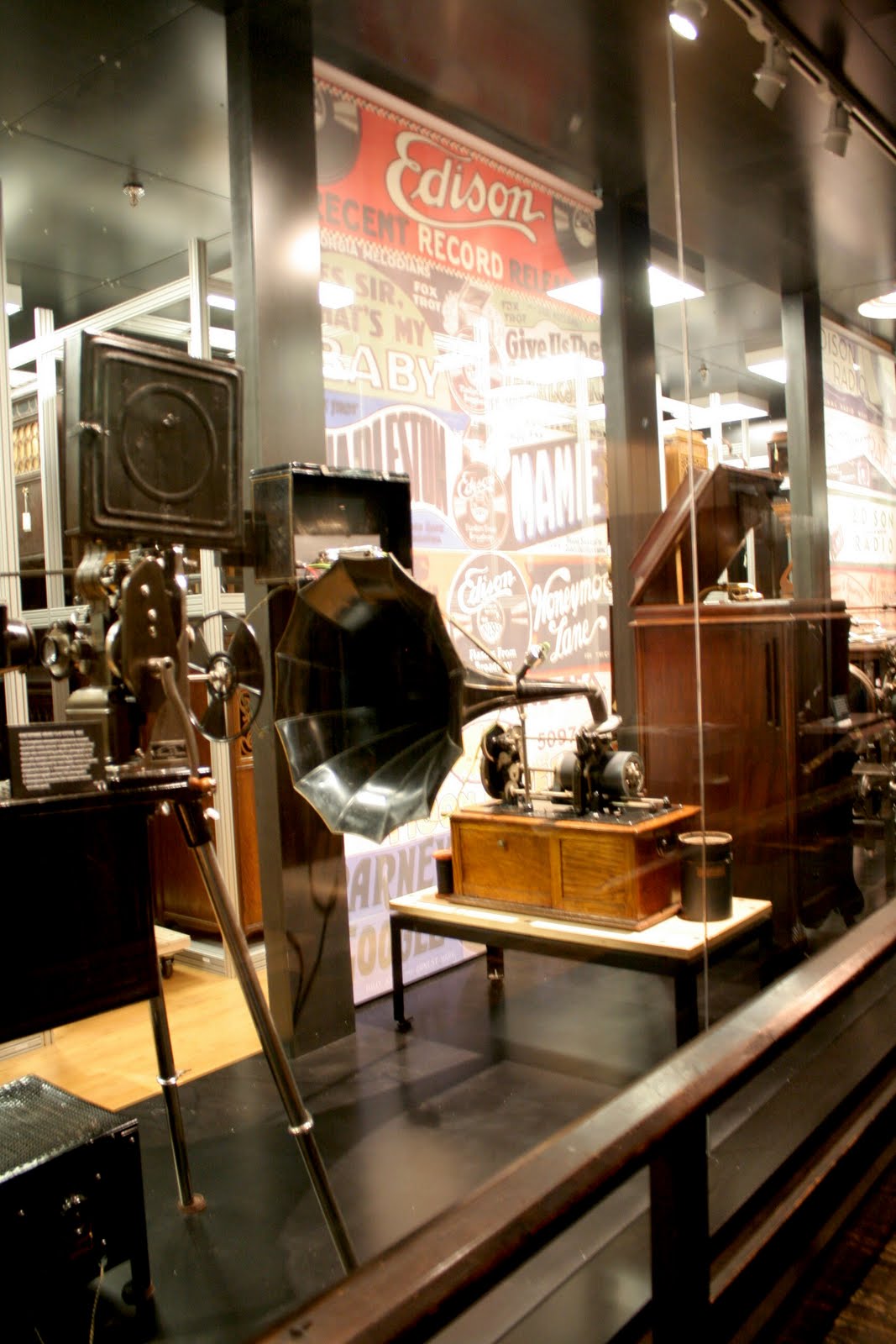
We spent several hours exploring the nearby Thomas Edison National Historical Park today. While I knew Thomas Edison (1847-1931) spent a large portion of his life right here in New Jersey, I never visited his laboratories or estate until today. Both his laboratories and his estate have been kept in near the exact same condition they were when fully functional, including the furniture and decorations in his home as well as all kinds of machinery, equipment, materials and chemicals in his labs.

Thomas Edison is one of America's most impressive inventors and is most famous for inventing the light bulb, the phonograph, and the motion picture camera. These three inventions are incredibly impressive and have had a tremendous impact on the industrialization of the world. In addition, Thomas Edison was a scientist and business man. He researched, experimented, manufactured and sold many inventions. He was just as much a businessman and entrepreneur as he was an inventor. He lead such a productive, accomplished life.

I enjoyed learning more about history that was made in my local area, but I also had a lot of fun simply taking photos of Edison's laboratories, factories, and home. I took 145 photos but these are my favorites. Not all of them are an enlightening representation of all the ingenuity that went on at Edison's laboratories, but they're photos that pleased me for some reason or another.

I love the look of these old bottles on the shelves.


Of course I had to photograph the bookshelves!


After the chemistry laboratory, we went into the factory where Edison's inventions were manufactured and mass produced.

In addition to the factory areas where production took place, the factory also housed a music room, drafting rooms, photography rooms, stock rooms, and even a library.

The library was at one end of the factory and went up three stories. The woodwork was stunning, as were the number of books. He thought of everything. Even a cot within an alcove of books. Looks like a perfect spot for a nap, doesn't it?

Displays of various phonographs


The Ediphone.


More glass bottles, neatly arranged and a beautiful old desk.

Buckets of sand for extinguishing fires in the machine shops.

Various signs posted throughout the machine shops:

A chart of decimal equivalents.


Air raid instructions.

A calendar from January 1919.

The world's first talking doll was invented by Thomas Edison in 1890 with a miniature phonograph inside it.

A desk in the photography room.


Thomas Edison's Estate called Glenmont. There was a stage set on the lawn in front, I believe for a special event held there just yesterday for Thomas Edison Day.


I am very grateful Edison invented the lightbulb... but I'm also pretty darned grateful for whomever it was who invented the automatic washing machine! These sinks are in the laundry room of the estate. I imagine one is for scrubbing the clothes, one is for soaking and one is for rinsing? I'd be doing laundry all day long!


I couldn't resist taking a photo of the simple roses outside the home.


What are some historical landmarks near you?


Thursday, January 7, 2010

Year of the Historical Reading Challenge


Host: KMont of Lurv a la Mode

Details: For more details, including rules and how to sign yourself up, visit KMont at Year of the Historical Reading Challenge.

Challenge: Read and review 12 historical fiction novels in 2010.

I joined KMont's Year of the Category Romance Reading Challenge last year and came up short. This year, KMont is challenging readers to read 12 historical novels. The books do not need to be historical romances--just historical fiction, but I'm thinking all of my selections will be historical romances since I read 17 historical romances last year.

Coincidentally, I'm in the middle of reading my first novel of 2010 and it's an historical romance. I'm reading Wild Heart by Lori Brighton and I'm really enjoying it. I'm a little over halfway through the novel and I'm at a scene where the heroine has just gotten dressed for a ball and I was so excited that the cover art shows her in the exact attire that she's wearing in this scene. Right down to the necklace! It may seem trivial, but I just love when a book's cover art perfectly matches what's inside the book.

So I realize the rules of this challenge call for a review of each book read, but I know me and my lack of discipline when it comes to writing reviews promptly or at all, for that matter, so I'm going to keep a list here just to humor myself and anyone else who's going to keep tabs on me and my challenges. ;p

1. Wild Heart by Lori Brighton
2. A Matter of Class by Mary Balogh
3. Proof of Seduction by Courtney Milan
4. My Unfair Lady by Kathryne Kennedy
5. Ravishing in Red by Madeline Hunter
6. Ten Things I Love About You by Julia Quinn
7. Provocative In Pearls by Madeline Hunter
8. Wicked Becomes You by Meredith Duran
9. One Dance With a Duke by Tessa Dare
10. The Taming of Mei Lin by Jeannie Lin
11. Butterfly Swords by Jeannie Lin
12. Twice Tempted by a Rogue by Tessa Dare 
13. The Devil Wears Plaid by Teresa Medeiros
14. Three Nights with a Scoundrel by Tessa Dare
15. Beyond the Highland Mist by Karen Marie Moning (time travel)

Wednesday, February 18, 2009

REVIEW: Bound by Donna Jo Napoli

Published August 1, 2006.

Read and reviewed for the TBR Challenge hosted by avidbookreader.com and the YA Reading Challenge hosted by J.Kaye's Book Blog.


Bound is a Cinderella inspired story of a fourteen year old girl named Xing Xing living in a small village in northern China during seventeenth century Ming Dynasty with her Stepmother and half sister Wei Ping. Upon the death of Xing Xing's beloved father, Xing Xing became bound in servitude to her stepmother and half sister. She is barely treated better than a slave by Stepmother who not only insults and demeans Xing Xing, but also demands that Xing Xing perform all of the daily chores required to care for her and her daughter and their humble home. Xing Xing clings to the values taught to her by her mother and father, and also secretly practices the "three perfections" taught to her by her father--poetry, painting, and calligraphy. She finds solace in these arts, and in a beautiful carp that she befriends, if you will, in the spring from which she retrieves their daily water. Xing Xing treasures the carp more than anything, as she comes to believe the carp is the soul of her mother reincarnated.

Determined to find a suitable husband for Wei Ping, Stepmother acts against her late husband's wishes and begins the painful process of binding Wei Ping's feet in hopes that by making her feet smaller, she would be better fit as a man's wife. The process of binding girls' feet is always painful and dangerous, but is usually started when a girl is very young and still growing. As a young teen, Wei Ping is already full grown and having her feet bound now causes not only extreme pain, but also severe infection. Wei Ping's life threatening infection then becomes the catalyst for a series of dramatic events that could either ruin Xing Xing's future forever or grant her the freedom she's always longed for. The freedom to think and act for herself, unbound from servitude and unbound from the strict social expectations of a woman.

Bound is a stark, realistic retelling of the commonly known Cinderella type fairy tale. The setting of the story in ancient China, along with the historically accurate traditions of ancient Chinese culture help make this story incredibly realistic and offer the reader a stark look into the unfair expectations and treatment of women within the society. While the hardships faced by women during that time seem unjust and demeaning to the modern reader, the author was able to convey normalcy of those hardships during that particular time period for that culture.

In the traditional Western version of Cinderella, the stepmother and stepsisters are wicked, selfish, and ill-intentioned. Yet in Bound, the stepmother's actions are actually understandable and somewhat justified based on the norms of the ancient Chinese culture. This allows the reader to empathize with Stepmother to a certain degree, making the conflicts of the story not entirely black and white, which in turn gives this story more depth and complexity than the typical Cinderella story. No doubt, Stepmother does inevitably act in poor character, but she is driven by the need to literally survive and will stop at nothing to secure Wei Ping's and her own future by finding Wei Ping a husband. It truly is a matter of life or death for her and her daughter, and sadly, there is no obligation to secure Xing Xing's future or even to preserve her life.

Xing Xing is a lovely character. She is lonely and mourns the loss of her mother and father, both of whom she loved dearly and with whom she shared close relationships, yet despite this sorrow, Xing Xing is an optimistic young girl who through constant reflection of all her parents taught her, manages to maintain a love of life and a hope for a better future. Xing Xing is also insightful and clever, and learns when and where she should expose her skills in the arts where it can work to her advantage. Xing Xing is also empathetic and caring, especially towards Wei Ping and she does what she can to care for her and keep her spirits up. She is even gracious to Stepmother--at least until Stepmother betrays her in the worst way. Upon learning of Stepmother's betrayal, Xing Xing reflects on the following philosophy taught to her by her father. It is one of my favorite passages from Bound:

Learning is not the accumulation of knowledge, but rather, one thing only: understanding. To truly learn, you listened first with you ears, then with your heart, then with your qi.


Note: In traditional Chinese culture, every living thing possesses a qi. While its meaning is varied, it is largely thought of as the "flow of energy" that sustains a living thing.

I thoroughly enjoyed reading this story and found it to be a very unique and powerful rendition of the classic tale. At the end of the story, however, I wished it wasn't a retelling of the classic Cinderella, because I felt the lost slipper and Prince ending to be a bit anticlimactic. Through self reflection and self confidence bestowed upon her from her mother and father, Xing Xing grew from a child to an independent, brave young woman, and I wanted her to acquire her freedom being bound on her own, without the help of a Prince. While I understand that the story is bound by the constraints of the classic tale as well as by the realism of a woman's power in this time period, I felt the ending was rather incongruous with the rest of the story. However, it is still a wonderful, thought provoking story that shouldn't be missed.

Bound is a beautifully and poetically written retelling of the classic, familiar fairy tale-- a coming of age story that is enlightening and hopeful.

GRADE: B+